Academic CV template for Google Docs™ and Word
For PhD, postdoc and faculty applications. Publications, talks, teaching and grants each get their own section, and the CV grows as your record does.
- Parser read 32/32 fields
- 2+ pages
- US Letter and A4
- Google Docs and Word
- Times New Roman
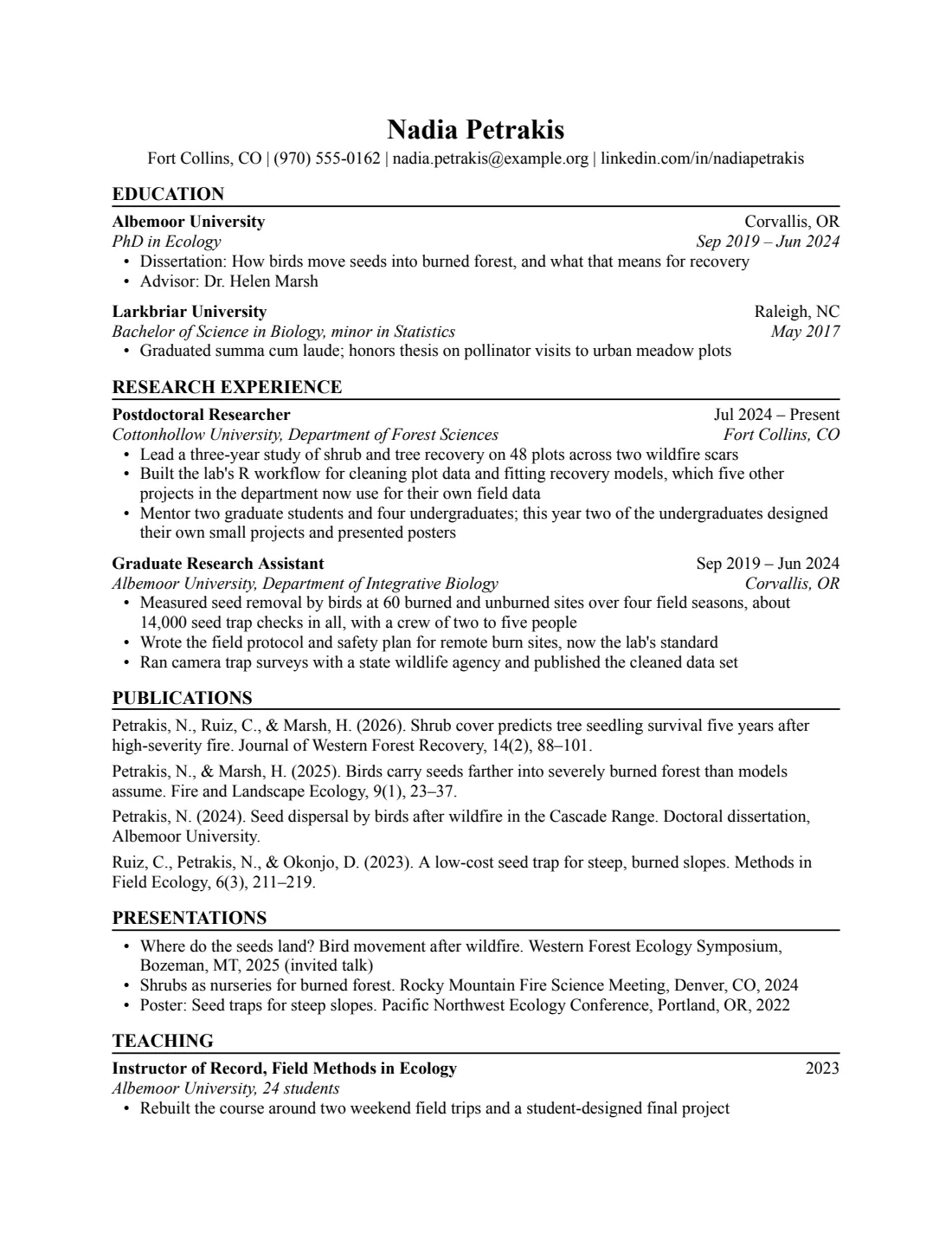
What a parser reads from it
Field by field, from the PDF that Google Docs exports.
32/32
fields read correctly from the resume (US Letter), downloaded from Google Docs as a PDF and read by the open-source OpenResume parser (commit 4f8255a) on Oct 5, 2026.
What the parser read
First 30 lines, exactly as extracted.
Nadia Petrakis
Fort Collins, CO | (970) 555-0162 | nadia.petrakis@example.org | linkedin.com/in/nadiapetrakis
EDUCATION
Albemoor University    Corvallis, OR
PhD in Ecology    Sep 2019 – Jun 2024
•    Dissertation: How birds move seeds into burned forest, and what that means for recovery
•    Advisor: Dr. Helen Marsh
Larkbriar University    Raleigh, NC
Bachelor of Science in Biology, minor in Statistics    May 2017
•    Graduated summa cum laude; honors thesis on pollinator visits to urban meadow plots
RESEARCH EXPERIENCE
Postdoctoral Researcher    Jul 2024 – Present
Cottonhollow University, Department of Forest Sciences    Fort Collins, CO
•    Lead a three-year study of shrub and tree recovery on 48 plots across two wildfire scars
•    Built the lab's R workflow for cleaning plot data and fitting recovery models, which five other
projects in the department now use for their own field data
•    Mentor two graduate students and four undergraduates; this year two of the undergraduates designed
their own small projects and presented posters
Graduate Research Assistant    Sep 2019 – Jun 2024
Albemoor University, Department of Integrative Biology    Corvallis, OR
•    Measured seed removal by birds at 60 burned and unburned sites over four field seasons, about
14,000 seed trap checks in all, with a crew of two to five people
•    Wrote the field protocol and safety plan for remote burn sites, now the lab's standard
•    Ran camera trap surveys with a state wildlife agency and published the cleaned data set
PUBLICATIONS
Petrakis, N., Ruiz, C., & Marsh, H. (2026). Shrub cover predicts tree seedling survival five years after
high-severity fire. Journal of Western Forest Recovery, 14(2), 88–101.
Petrakis, N., & Marsh, H. (2025). Birds carry seeds farther into severely burned forest than models
assume. Fire and Landscape Ecology, 9(1), 23–37.
Petrakis, N. (2024). Seed dispersal by birds after wildfire in the Cascade Range. Doctoral dissertation,
Field by field
What we wrote, and what the parser put in each field.
| Field | Parser read | Match |
|---|---|---|
| Name | Nadia Petrakis | |
| nadia.petrakis@example.org | ||
| Phone | (970) 555-0162 | |
| Location | Fort Collins, CO | |
| Link | linkedin.com/in/nadiapetrakis | |
| Summary | (empty) | |
| Job 1 company | Cottonhollow University, Department of Forest Sciences | |
| Job 1 title | Postdoctoral Researcher | |
| Job 1 dates | Jul 2024 – Present | |
| Job 1, bullet 1 | Lead a three-year study of shrub and tree recovery on 48 plots across two wildfire scars | |
| Job 1, bullet 2 | Built the lab's R workflow for cleaning plot data and fitting recovery models, which five other projects in the department now use for their own field data | |
| Job 1, bullet 3 | Mentor two graduate students and four undergraduates; this year two of the undergraduates designed their own small projects and presented posters | |
| Job 2 company | Albemoor University, Department of Integrative Biology | |
| Job 2 title | Graduate Research Assistant | |
| Job 2 dates | Sep 2019 – Jun 2024 | |
| Job 2, bullet 1 | Measured seed removal by birds at 60 burned and unburned sites over four field seasons, about 14,000 seed trap checks in all, with a crew of two to five people | |
| Job 2, bullet 2 | Wrote the field protocol and safety plan for remote burn sites, now the lab's standard | |
| Job 2, bullet 3 | Ran camera trap surveys with a state wildlife agency and published the cleaned data set | |
| School 1 | Albemoor University | |
| School 1 degree | PhD in Ecology | |
| School 1 dates | Sep 2019 – Jun 2024 | |
| School 1 GPA | (empty) | |
| School 1, bullet 1 | Dissertation: How birds move seeds into burned forest, and what that means for recovery | |
| School 1, bullet 2 | Advisor: Dr. Helen Marsh | |
| School 2 | Larkbriar University | |
| School 2 degree | Bachelor of Science in Biology, minor in Statistics | |
| School 2 dates | May 2017 | |
| School 2 GPA | (empty) | |
| School 2, bullet 1 | Graduated summa cum laude; honors thesis on pollinator visits to urban meadow plots | |
| Skills line 1 | Analysis: R (lme4, brms), Python, QGIS | |
| Skills line 2 | Fieldwork: Seed traps, camera traps, plot surveys | |
| Skills line 3 | Languages: English (native), Greek (conversational) |
Shown but not counted
- Corvallis, OR: no location field for schools. It's in the extracted text.
- Raleigh, NC: no location field for schools. It's in the extracted text.
- Fort Collins, CO: no location field for jobs. It's in the extracted text.
- Corvallis, OR: no location field for jobs. It's in the extracted text.
- Petrakis, N., Ruiz, C., & Marsh, H. (2026). Shrub cover predicts tree seedling survival five years after high-severity fire. Journal of Western Forest Recovery, 14(2), 88–101.: no field for this section in the parser. It's in the extracted text.
- Petrakis, N., & Marsh, H. (2025). Birds carry seeds farther into severely burned forest than models assume. Fire and Landscape Ecology, 9(1), 23–37.: no field for this section in the parser. It's in the extracted text.
- Petrakis, N. (2024). Seed dispersal by birds after wildfire in the Cascade Range. Doctoral dissertation, Albemoor University.: no field for this section in the parser. It's in the extracted text.
- Ruiz, C., Petrakis, N., & Okonjo, D. (2023). A low-cost seed trap for steep, burned slopes. Methods in Field Ecology, 6(3), 211–219.: no field for this section in the parser. It's in the extracted text.
- Where do the seeds land? Bird movement after wildfire. Western Forest Ecology Symposium, Bozeman, MT, 2025 (invited talk): no field for this section in the parser. It's in the extracted text.
- Shrubs as nurseries for burned forest. Rocky Mountain Fire Science Meeting, Denver, CO, 2024: no field for this section in the parser. It's in the extracted text.
- Poster: Seed traps for steep slopes. Pacific Northwest Ecology Conference, Portland, OR, 2022: no field for this section in the parser. It's in the extracted text.
- Instructor of Record, Field Methods in Ecology: no field for this section in the parser. It's in the extracted text.
- 2023: no field for this section in the parser. It's in the extracted text.
- Albemoor University, 24 students: no field for this section in the parser. It's in the extracted text.
- Rebuilt the course around two weekend field trips and a student-designed final project: no field for this section in the parser. It's in the extracted text.
- Teaching Assistant, Introduction to Ecology: no field for this section in the parser. It's in the extracted text.
- 2019 – 2022: no field for this section in the parser. It's in the extracted text.
- Albemoor University, four terms, labs of about 30 students: no field for this section in the parser. It's in the extracted text.
- Thornholme Foundation Early Career Fellowship, $45,000, 2025: no field for this section in the parser. It's in the extracted text.
- Albemoor University Graduate Research Grant, $6,500, 2022: no field for this section in the parser. It's in the extracted text.
- Best Student Poster, Pacific Northwest Ecology Conference, 2022: no field for this section in the parser. It's in the extracted text.
- Peer reviewer for Fire and Landscape Ecology and Methods in Field Ecology: no field for this section in the parser. It's in the extracted text.
- Graduate student representative on the department hiring committee, 2022 – 2023: no field for this section in the parser. It's in the extracted text.
This checks our sample text, read by one open-source parser from the PDF that Google Docs' File > Download > PDF produces. It isn't a score, and it doesn't tell you how Workday, Greenhouse or any other hiring system will read your own resume. Anyone can rerun it: the test repository has the PDF (SHA-256 37e9b1e12858…), the expected values and the raw results. How we test
How an academic CV differs from a resume
A resume is a one- or two-page summary chosen for one job. An academic CV is the full record: every degree, publication, talk, course taught and grant, in reverse order. It gets longer every year, and nobody expects it to fit on one page. Search committees read it to judge your research and teaching, so the order of sections matters more than the design.
The usual order
- Education. Degrees with the institution, field and year. Add your dissertation title and advisor under the PhD.
- Appointments or research experience. Postdocs, faculty positions and research roles, most recent first.
- Publications. In the citation style your field uses, with your name in the same form every time. Separate peer-reviewed articles from other writing once you have several.
- Presentations. Invited talks first, then conference talks and posters.
- Teaching. Courses you taught as instructor of record, then teaching assistant roles.
- Grants and awards, service, skills. Funding with amounts, then reviewing, committees and outreach, then methods and languages.
For a teaching-focused job, move Teaching above Publications. For a postdoc, keep research first and trim service to a few lines.
Listing publications
Use one citation style throughout, list the most recent first, and mark anything not yet published as “under review” or “in press”. Don't list a paper as forthcoming unless it has been accepted. The template sets publications without bullets, so long citations wrap cleanly and read like a reference list.
Coming from LaTeX?
Many academic CVs start in Overleaf. To move yours, copy the text from the compiled PDF into this template one section at a time. Our LaTeX to Google Docs guide covers what carries over and what doesn't.
About the parser test
The open-source parser we test with only knows the sections a resume has: education, experience, projects, skills and a summary. On this CV it reads all of those correctly. Publications, presentations, teaching, grants and service have no field in the parser, so we check that their text comes out whole and in order and list them as outside the parser's scope rather than counting them. Details are in the panel above and on how we test.
Specs and editing tips
Everything you need to edit it without breaking the layout.
Specs
- Font
- Times New Roman, installed on Windows and macOS, so the .docx keeps its look
- Body text
- 11 pt
- Margins
- 1 in (Letter), 25 mm (A4)
- Length
- 2+ pages with the sample content
- Sections
- Education, Research Experience, Publications, Presentations, Teaching, Grants and Awards, Service, Skills
- Good for
- PhD students, postdocs, faculty
- Layout
- One column, no tables, text boxes, images or icons. Dates aligned with a right tab stop.
Editing tips
- Dates stay on the right by themselves. Each heading line has a right-aligned tab stop. Press Tab before the date instead of adding spaces.
- Add a job by copying one. Select a whole entry, heading lines and bullets, copy it and paste it below. The spacing comes with it.
- Running long? Cut older and minor items before you shrink anything. Keep body text at 10.5 pt or larger.
- Rename your copy. Recruiters see the file name, so use something like Firstname-Lastname-Resume.
Exporting your finished resume
Two downloads from Google Docs cover almost every application.
File > Download > PDF Document. This is the exact path we test on every release. It gives selectable text with the fonts embedded.
Word
File > Download > Microsoft Word (.docx). Our own .docx files are exported this way, and we check that text and bullets survive. Don't convert a PDF to Word.
Similar templates
Same rules, a different look.
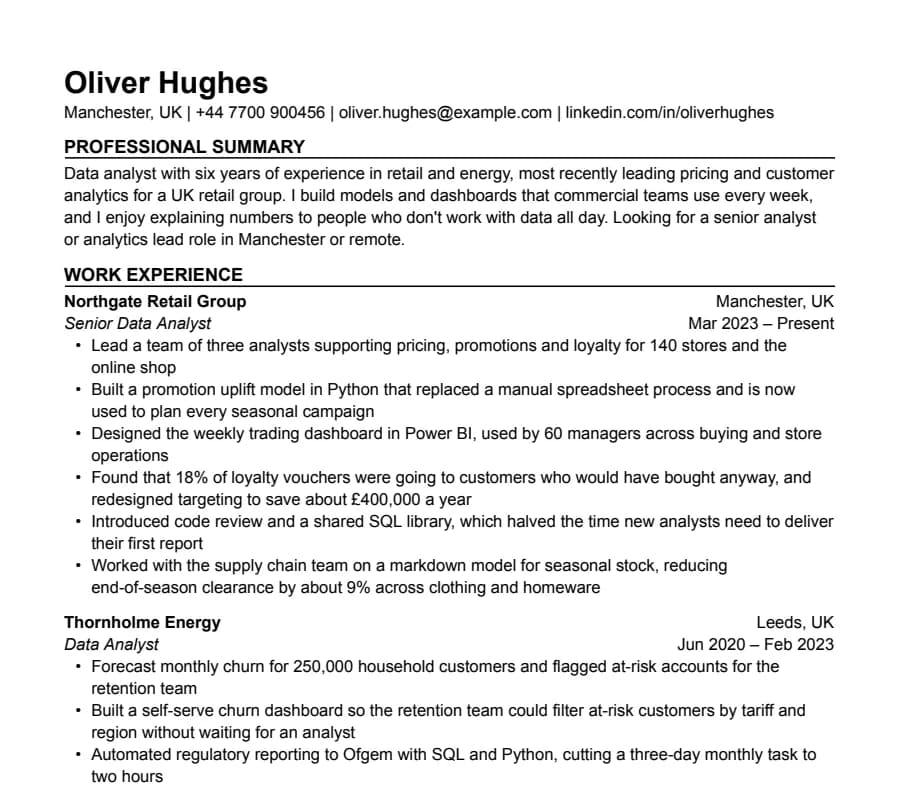
International CV
63/63 fields read
A4, no photo, a professional summary at the top and room for two pages. Written the way UK and European employers expect a CV.
- Up to 2 pages
- Letter + A4
- Docs + Word
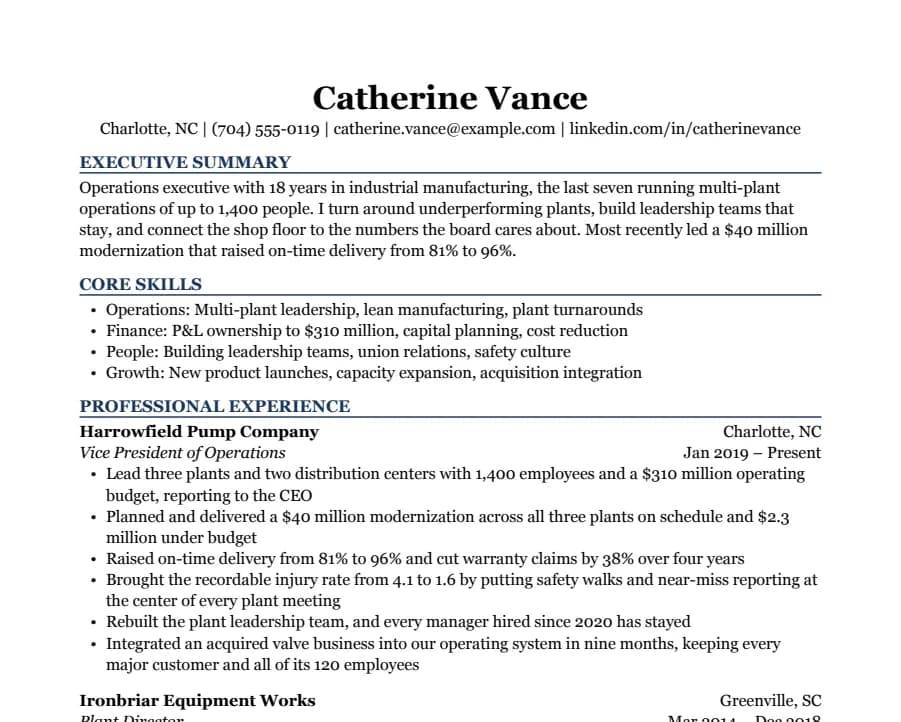
Executive
53/53 fields read
Two pages for senior leaders: an executive summary, core skills, then each role written as results. Navy headings in Georgia.
- 2 pages
- Letter + A4
- Docs + Word
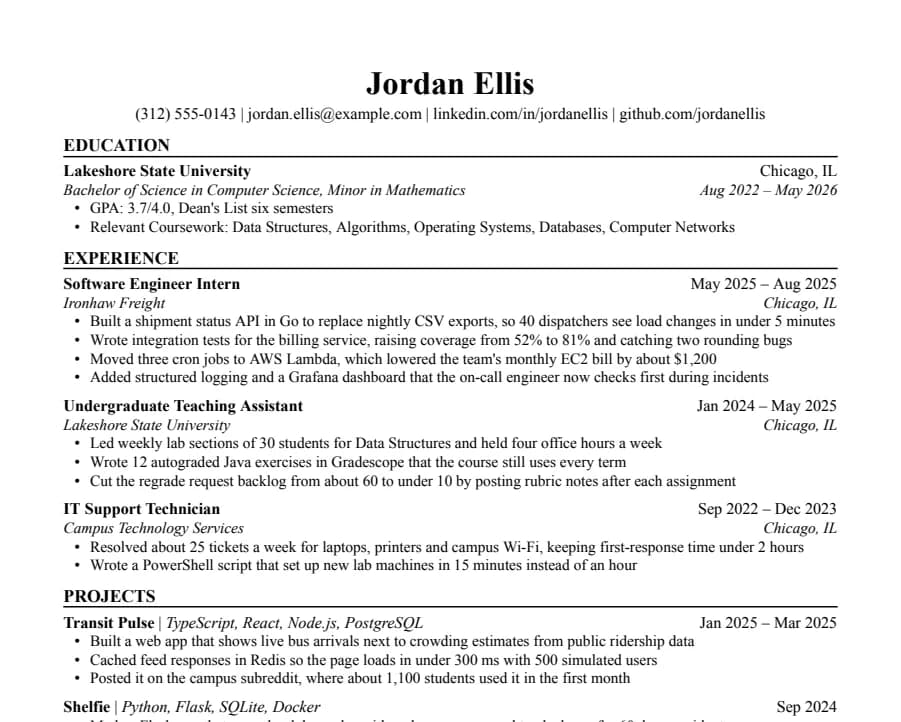
Jake's
46/46 fields read
The Jake's Resume layout rebuilt for Google Docs and Word. Dense, centered, made for tech internships and new-grad roles.
- 1 page
- Letter + A4
- Docs + Word
Questions
- How long should an academic CV be?
- As long as your record. Two pages is typical for a PhD student, three to five for a postdoc, and much longer for senior faculty. Don't cut real work to save space, but do drop minor items once you have stronger ones.
- Is a PhD CV different from a faculty CV?
- Same structure, different weight. As a PhD student, lead with education and research experience and include conference posters. As faculty, appointments, grants and teaching carry more of the page.
- Should an academic CV have a summary?
- Usually not in the US. Committees read your research and teaching statements for that. A short profile is more common for industry jobs or CVs used outside academia.
- Can I use this for a job outside academia?
- For most industry jobs, turn it into a resume: one or two pages, results first, and only the publications that matter for the role. Our Two-page Professional template works well for that.
- Can my name have accents or non-Latin characters?
- Yes, with one caveat. In our tests the parser read José Álvarez, Mary-Jane Smith, Sean O'Brien and Иван Петров correctly, and the layout didn't move. A Chinese name like 王小明 also kept the page intact, but Google Docs swaps in a Japanese font for those characters and the parser left the name field empty. For US applications, put the romanized name first, like Xiaoming Wang (王小明). Phone numbers outside the US format, like +44 7700 900123, aren't picked up as phone numbers either.